Canadian Critical Care Nursing Standards Revision Part 1: A Scoping Review
Sarah Crowe, MN, PMD-NP(F), NP, CNCC(C), Brandi Vanderspank-Wright, PhD, RN CNCC(C) and Amanda Ross-White, MLIS, AHIP for the Canadian Association of Critical Care Nurses – National
Abstract
Background & Purpose: Critical care nursing demands high professional standards to safeguard patient outcomes. The Canadian Association of Critical Care Nurses (CACCN) publishes national standards to define and guide the practice of Canadian critical care nurses (CCNs). To ensure credibility, transparency, and methodological rigor in revising these standards, this scoping review was conducted as the first phase of a standardized protocol to inform the sixth edition of CACCN’s Standards for Critical Care Nursing Practice.
Methods & Procedures: Guided by the JBI methodology for scoping reviews, the research protocol was developed a priori and executed across Medline, CINAHL, and Nursing & Allied Health databases. Peer-reviewed articles and grey literature from 2017–2022 were screened using Covidence software in a two-stage process by independent reviewers. Grey literature was sourced through targeted searches of critical care associations globally. Inclusion criteria required documents to contain published or public-facing standards related to critical care nursing practice.
Results: The review included 15 sources: 5 peer-reviewed studies and 10 grey literature documents. Standards were identified from 12 countries and federations. Key topics varied widely, encompassing educational requirements, ethical practice, clinical competencies, advocacy, leadership, communication, staffing, and safety. Most sources described the frameworks used to develop their standards.
Discussion: Results revealed variation across regions, highlighting the lack of a universal framework. This variation underscores the need for standardized methodologies to ensure consistency in CCN practice.
Conclusion: This review lays the foundation for evidence-based revision of CACCN’s standards and supports the development of a structured approach to future updates.
Key Words: Critical Care Nursing, Practice Standards, Scoping Review, Evidence-Based Practice
Implications for Nurses
- Standardization Promotes Consistency: The absence of a unified approach to developing critical care nursing standards globally underscores the need for standardized, evidence-based methodological frameworks for standards development. Implementing such approaches, such as scoping reviews to identify existing standards followed by a consensus-building methods like the modified-Delphi, ensures transparency, replicability, and consistency in how standards are created and revised.
- Informed Practice Through Rigorous Review: Conducting a structured scoping review allows nurses to base their practice on current, peer-reviewed, and grey literature. This promotes informed clinical decision-making that reflects evolving healthcare trends and best practices.
Critical care nursing is a disciplinary specialization that requires the highest standard of practice to ensure the safety and well-being of critically ill patients (AACN, 2019; ACCN, 2015; CACCN, 2017). The Canadian Association of Critical Care Nurses (CACCN), the national professional body representing critical care nurses (CCNs), has been committed to setting, maintaining, and promoting practice standards that define the roles, responsibilities, and quality of critical care nursing practice (CACCN, n.d.) since 1992. The CACCN (2017) has actively promoted the Standards of Critical Care Nursing Practice as one of its foremost mandates as an Association, ensuring that Canadian CCNs deliver high-quality, patient- and family-centred care in critical care units, where patients are often gravely ill, vulnerable, and where clinical decisions often carry significant consequences. Standards of care serve as a legal and professional framework, that outlines what constitutes “safe and appropriate patient care” (Shapiro, 2019, p.102). These standards compel nurses to deliver care that is knowledgeable, competent, and safe, always prioritizing their patients’ best interests of (Shapiro, 2019). Beyond legal implications, standards of practice delineate the roles, responsibilities, and scope of CCNs, thereby ensuring clarity and consistency in nursing roles and promoting a unified approach to care delivery (Shapiro, 2019).
The Standards for Critical Care Nursing Practice published by CACCN (2017) serve as an essential resource for Canadian CCNs. They provide broad, high-level direction that can be tailored to meet the specific needs of individual units and critically ill patient populations. These standards not only establish a benchmark for best practice in critical care nursing but also promote a culture of continuous improvement and professional accountability within critical care settings. By adapting the standards at the unit level, CCNs can ensure that the care delivered is both evidence-informed and responsive to the unique needs of patients and families accessing critical care services across Canada. The Canadian Standards for Critical Care Nursing Practice have undergone periodic revisions to stay current with evolving knowledge, technology, and patient care practices. The most recent revision, completed in 2017, marked the fifth revision of these standards since their inception. Historically, the development and revisions to these standards have involved robust literature reviews and expert input from experienced Canadian CCNs (Kidd et al., 1987). However, despite these efforts to incorporate rigorous review processes, a clearly defined and standardized methodological approach has not been consistently applied across all revisions. The absence of a structured process poses challenges to ensuring the transparency, reproducibility, and comprehensiveness of the standards.
To address this gap, there was an identified need to implement a standardized methodological framework for the development and revision of CACCN’s standards. Having a standardized process serves to not only enhance the quality and credibility of the standards but also facilitate a more transparent and replicable review process for future revisions. Utilizing a structured protocol ensures that the resulting standards are evidence-based, systematically developed, providing alignment with the best available evidence as well as national CCN expert consensus. The protocol for the standards revisions was published in advance, ensuring transparency and adherence to a pre-established methodological framework (Vanderspank-Wright & Crowe, 2023). This manuscript reports on part one of the process which was a scoping review that was conducted a priori to the modified Delphi (Vanderspank-Wright & Crowe, 2023). Modelled on the JBI methodology for scoping reviews (Aromataris et al., 2024), this review reports on the methods used to search for and subsequently identify key literature that was used to inform the modified Delphi and subsequently inform the development of the sixth edition of the CACCN’s Standards for Critical Care Nursing Practice.
Methods
Protocol
The research protocol for the Standards revision was developed a priori (Vanderspank-Wright & Crowe, 2023) and modelled on the JBI methodology for scoping reviews (Aromataris et al., 2024). Although the protocol was not formally registered, the JBI methodology was determined to be well-suited for this review purpose offering a structured approach to identifying, analyzing, and synthesizing evidence, thereby supporting the development of comprehensive, high-quality standards.
Eligibility
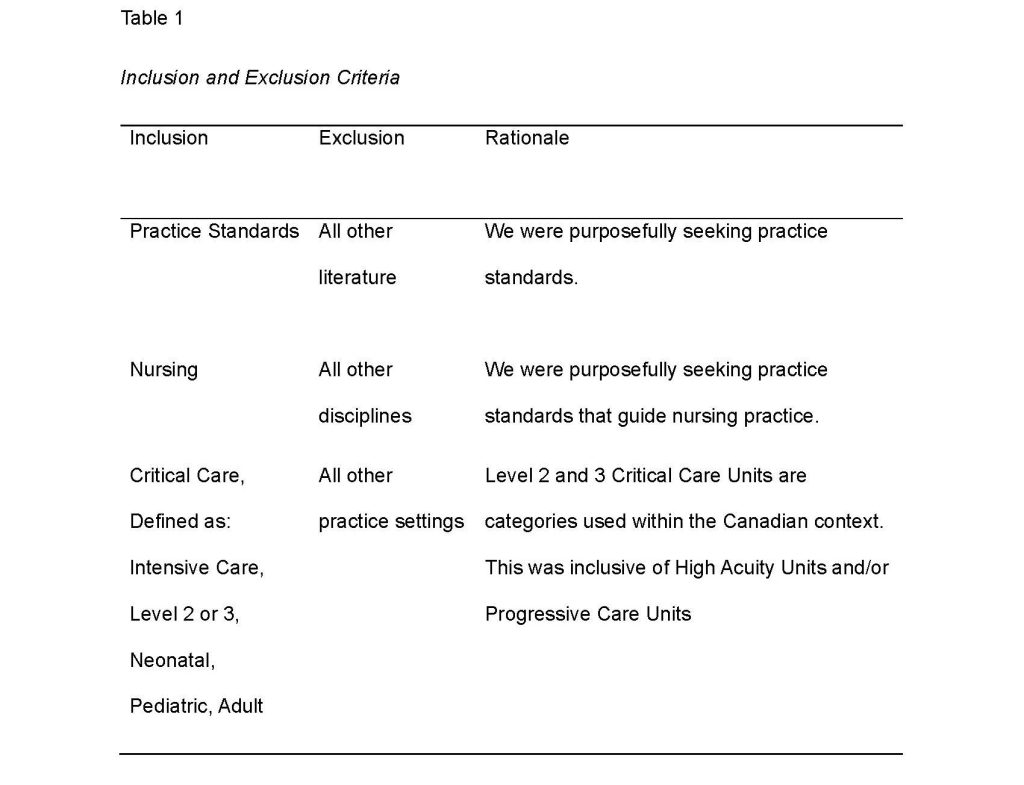
To be eligible for inclusion in this review, manuscripts and grey literature needed to include published or public-facing standards for critical care nursing practice. Table 1 further outlines inclusion and exclusion criteria along with an associated rationale.
In consultation with a medical information specialist, we developed a rigorous and replicable search strategy to identify existing critical care nursing standards literature. The search strategy was developed in Medline and peer reviewed (See Figure 1 for Medline Search Strategy). The search strategy was then translated and executed into the remaining databases. The following databases were searched: Medline (OVID), CINAHL (EbscoHost), Nursing & Allied Health (ProQuest).
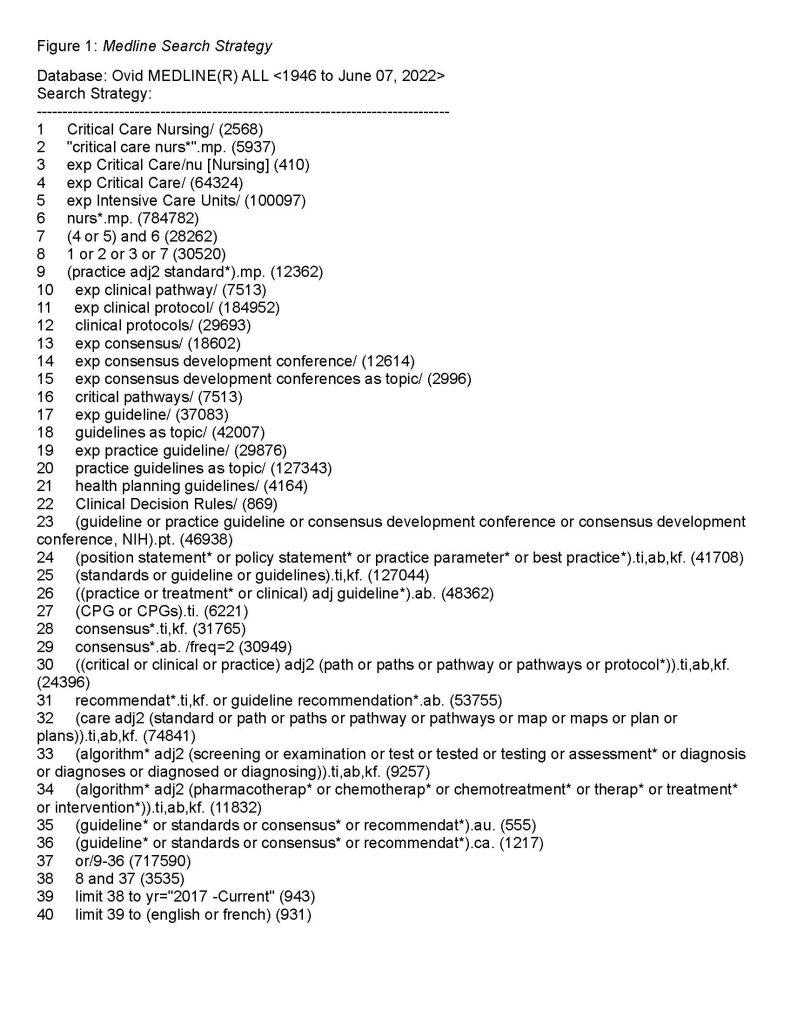
The search was completed in two steps. First, we conducted a structured search of peer‑reviewed literature on critical care nursing standards of practice. We limited the search to 2017–June 7, 2022, to align with the publication of the 5th edition of the CACCN Standards (2017) and the initiation of revisions in June 2022. Language limits were set to English and French, Canada’s official languages. Citations were retrieved and uploaded into Covidence systematic review software for screening. All duplicates were removed. We used a two-step screening process completed by two independent reviewers (Initials Blind for Review). First, the titles and abstracts were screened followed by full-text screening. In instances where consensus was needed, the two principal investigators (Initials Blind for Review) discussed and reached consensus. A review of reference lists of included articles was also done to satisfy hand-searching.
Our second step was to conduct a robust pre-established, grey literature search. Given the Canadian healthcare structure, which is under the auspices of individual provinces and territories, we collected all existing critical care nursing standards in Canada. In addition, we searched major critical care nursing associations and federations, including the Canadian Association of Critical Care Nurses (CACCN), the American Association of Critical Care Nurses (AACN), the Australian College of Critical Care Nurses (ACCCN), the European Federation of Critical Care Nursing Associations (EfCCNa), and other national bodies identified through the World Federation of Critical Care Nurses (WFCCN) membership list. This process involved systematic review of association websites and direct contact with organizations when necessary to ensure comprehensiveness. To maximize inclusivity, we included all available standards in English or French and used the most recent versions available, regardless of their publication date.
Results
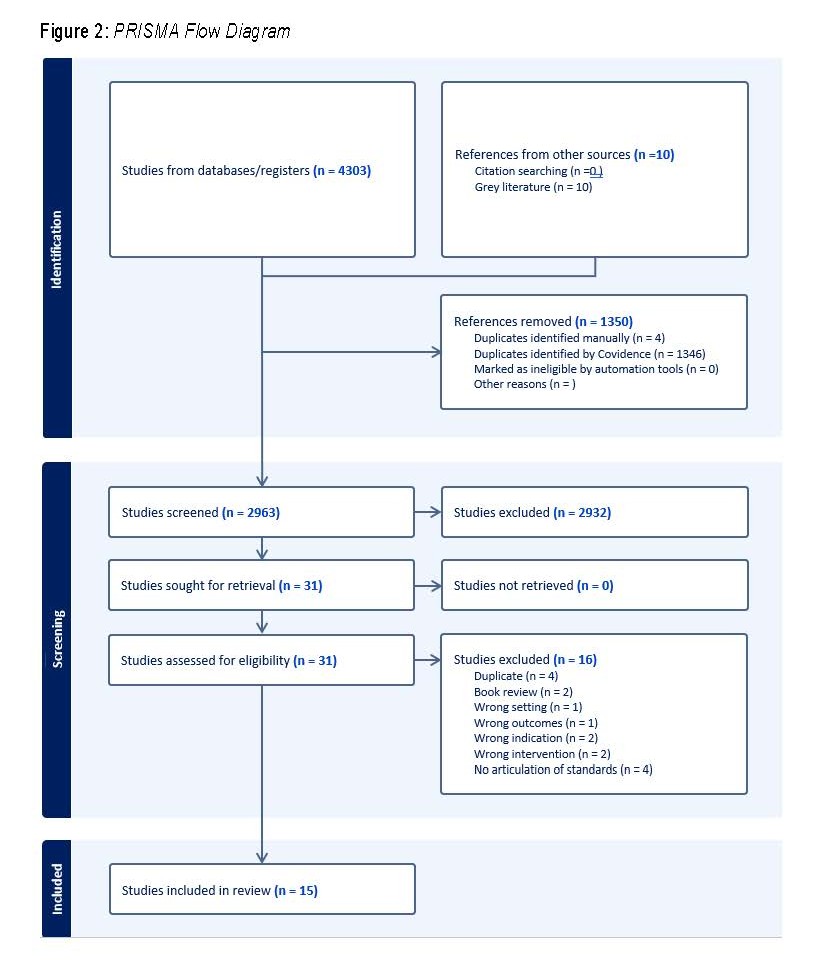
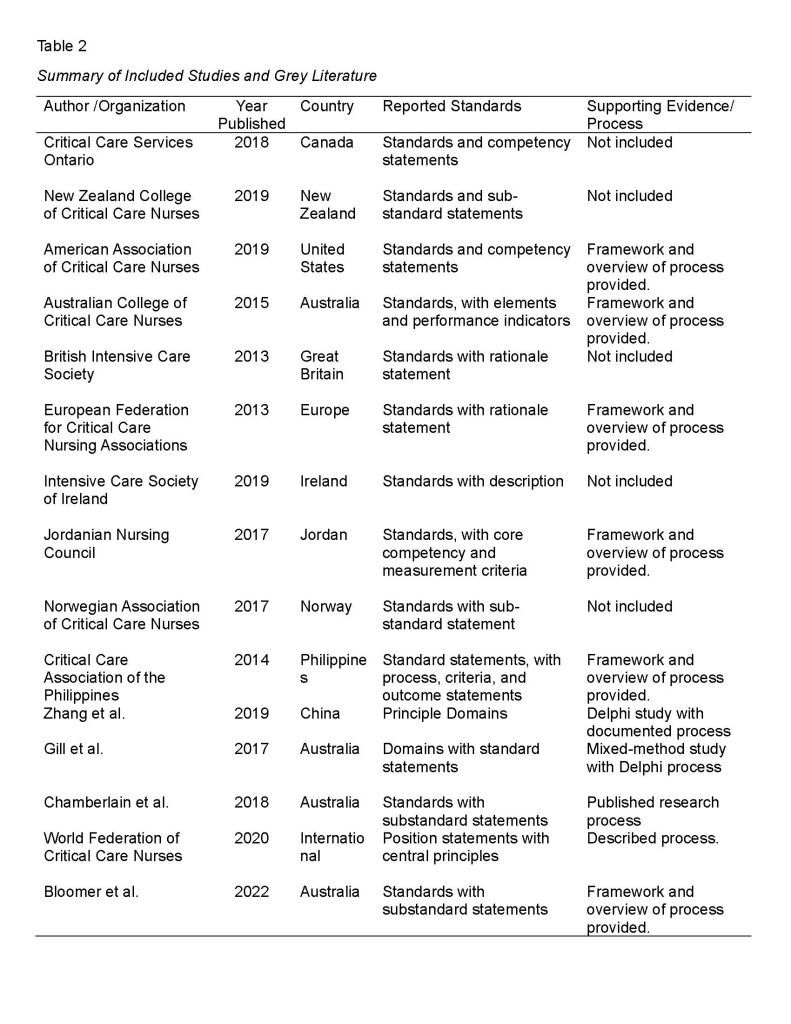
The initial search of electronic databases yielded 4,303 citations. After removing duplicates, 2,953 unique titles and abstracts were screened (Figure 2). A total of 2,932 citations were excluded based on relevance, leaving 21 articles for full-text review. Sixteen additional articles were excluded at full-text screening for the following reasons: n = 4 were duplicates, n = 4 did not include extractable standards, n = 2 were book reviews, n = 2 addressed the wrong indication, n = 2 involved the wrong interventions, n = 1 was set in the wrong context, and n = 1 focused on the wrong outcome. This resulted in n = 5 studies being included. A hand search of grey literature was expanded to include all available critical care association standards where n = 10 additional relevant articles were identified. In total, 15 articles were included in the final review (Table 2). Further, it should be clarified that we included the existing CACCN 5th edition standards – these are not captured in the search, nor in the PRISMA. Consistent with scoping review methodology, we did not evaluate included articles for methodological quality (Peters et al., 2022).
Of the 15 articles included in the review, standards were identified from the following countries and federations: Canada (n = 1), the United States (n = 1), New Zealand (n = 1), Australia (n = 4), Great Britain (n = 1), Ireland (n = 1), Jordan (n = 1), Norway (n = 1), the Philippines (n = 1), China (n = 1), Europe (n = 1), and an international consortium (n = 1).
The majority of articles (n = 10) described the frameworks or processes used to develop their standards. These approaches included consensus‑building methods such as Delphi studies (e.g., Gill et al., 2017; Zhang et al., 2019); systematic literature reviews combined with expert panel input (e.g., Chamberlain et al., 2018); position statements and competency frameworks developed through professional association consultation (e.g., AACN, 2019; EfCCNa, 2013); and national policy‑driven processes (e.g., Critical Care Services Ontario, 2018; Jordanian Nursing Council, 2017). These frameworks varied in rigor and transparency, with some offering detailed methodological accounts (Delphi, systematic reviews) and others relying on expert consensus without clear documentation. This variation highlights the lack of a universally applied methodology for standards development.
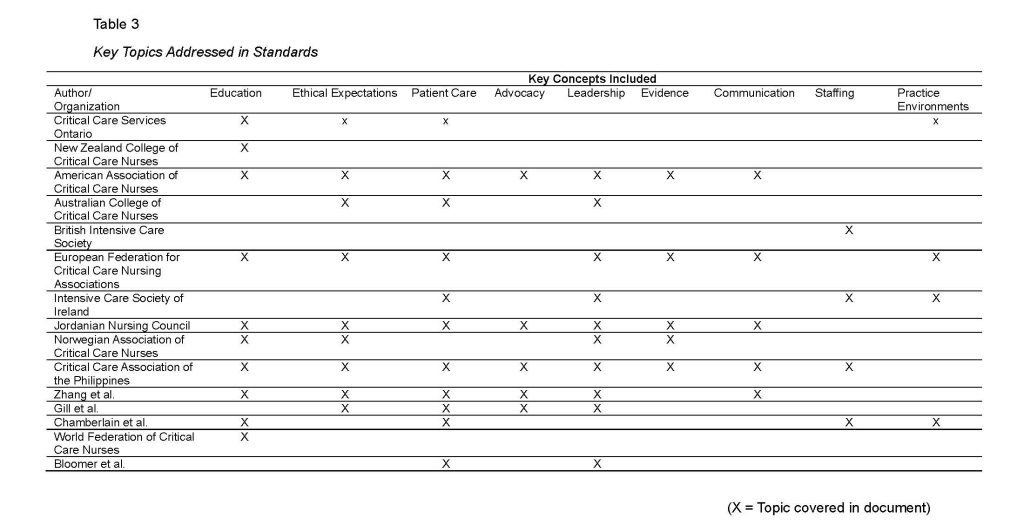
The included sources addressed a wide range of topics, including baseline education and competencies, ethical practice expectations, leadership and advocacy, staffing and safe practice environments (see Table 3). While most sources emphasized baseline education and ethical practice, fewer addressed leadership, advocacy, or evidence generation. This imbalance suggests that some aspects of critical care nursing practice remain underrepresented in global standards. Notably, frameworks that employed structured consensus methods (e.g., Delphi) tended to produce more comprehensive standards spanning multiple domains.
The findings from this scoping review provide the evidence base for the modified Delphi process guiding the sixth edition of CACCN’s Standards. The variation in frameworks across the literature underscores the importance of adopting a transparent and replicable methodology—combining the scoping review with the Delphi approach—to ensure credibility in the Canadian revision process. At the same time, the breadth of domains identified internationally supports the development of comprehensive standards that extend beyond clinical competencies to encompass leadership, advocacy, and ethical practice. Notably, gaps observed in existing standards, such as limited attention to evidence generation and communication, highlight opportunities for Canadian standards to lead by example. By synthesizing these diverse approaches, this review ensures that the CACCN revision process is firmly grounded in international evidence while remaining responsive to the Canadian context.
Discussion
The scoping review highlights the considerable variation in both the frameworks used to develop critical care nursing standards and the domains prioritized across international sources, as seen by Table 3. While some standards were developed through structured methodologies such as modified Delphi studies or systematic literature reviews, others relied primarily on expert consensus or position statements with limited methodological transparency. This inconsistency underscores the absence of a universally applied framework for standards development and reinforces the importance of adopting a transparent, replicable process for the Canadian context. By combining a systematic scoping review with a modified Delphi, the CACCN revision process directly addresses this gap, ensuring that the sixth edition of the Standards is both evidence-informed and methodologically rigorous.
Comparisons across the 15 sources revealed that education, ethical expectations, and patient care were consistently emphasized, whereas domains such as leadership, advocacy, evidence generation, and communication were less frequently represented. This imbalance suggests that while foundational competencies are widely recognized, broader aspects of professional practice remain underdeveloped in many jurisdictions. For Canada, this presents an opportunity to lead by example: integrating underrepresented domains into the revised Standards will not only strengthen the comprehensiveness of the framework but also align with the evolving role of critical care nurses as leaders, advocates, and contributors to evidence-based practice.
The international variation in domains and development processes have direct implications for the Canadian revision. These findings confirm the need for a comprehensive framework that integrates both foundational competencies and underrepresented areas such as evidence generation, communication, and interprofessional collaboration. Incorporating these domains into the CACCN Standards strengthens their relevance within Canada while contributing to broader international efforts toward greater alignment in critical care nursing practice.
Looking forward, the integration of diverse frameworks and domains into the modified Delphi process will ensure that the revised Standards are responsive to both Canadian healthcare needs and global trends. Future work should continue to evaluate the implementation and impact of these Standards, exploring how they influence patient outcomes, nurse retention, and professional development. By embedding methodological transparency and inclusivity into the revision process, Canada can establish a replicable model for standards development that promotes consistency, credibility, and high-quality care across critical care settings.
While this review highlights the lack of consistency across international standards, the question of whether a universal approach is required remains complex. A single global framework may not be feasible given the diversity of healthcare systems, regulatory environments, and cultural contexts. Instead, what is needed is a standardized methodological process for developing standards, such as the combination of scoping review and modified Delphi, paired with flexibility in content to reflect local practice environments. This balance ensures credibility and transparency while allowing adaptation to unique patient populations and system structures. For Canada, the scoping review provides the evidence base that will directly inform the modified Delphi process, ensuring that the sixth edition of CACCN’s Standards is comprehensive and methodologically rigorous. By grounding the revision in international evidence while tailoring domains to Canadian priorities, this process strengthens national practice while contributing to broader conversations about harmonization. In this way, the scoping review not only supports the CACCN revision but also offers a replicable model for other jurisdictions seeking to balance standardization with contextual flexibility.
Limitations
This scoping review has several limitations that should be acknowledged. First, while the research protocol was developed a priori and modelled on JBI methodology, it was not formally registered in a public repository, which may limit external verification of the process. Second, the search strategy was restricted to English and French language sources, potentially excluding relevant standards published in other languages. Third, although grey literature was systematically sought through targeted searches of critical care associations, unpublished or inaccessible standards may not have been captured. Fourth, consistent with scoping review methodology, included sources were not appraised for methodological quality, which may affect the strength of the evidence underpinning some standards. Finally, the review was limited to literature published between 2017 and 2022 to align with the timeline of the CACCN’s fifth edition standards; while this ensured relevance to the current revision process, it may have excluded earlier standards that remain influential in some contexts.
Conclusion
The findings from this scoping review provide an overview of existing published peer-reviewed literature as all as public-facing grey literature that specifically outlines standards for critical care nursing practice globally. This literature highlights the current landscape of critical care nursing standards, potentially identifying areas that require attention in Standards development for CCNs, such as baseline education, ethical practices, patient care, and leadership. By synthesizing this diverse range of topics that are addressed in Standards globally, the scoping review offers valuable insights into the priorities and expectations that shape critical care nursing practice. Furthermore, the review emphasizes the importance of developing a standardized methodological framework for revising standards, ensuring they are evidence-based and aligned with the best available research and expert consensus. Such a framework will enhance the quality and credibility of critical care nursing standards, promoting consistency and clarity in nursing roles and responsibilities.
In conclusion, this scoping review identified all published standards relevant to critical care nursing, thereby establishing the evidence base for the modified Delphi process that will guide the revision of the CACCN’s Standards for Critical Care Nursing Practice. By documenting a transparent search strategy and inclusion criteria, this review ensures that the standards development process is both replicable and grounded in the full scope of literature available. This methodological foundation supports the goal of ensuring that critical care nursing practice in Canada remains responsive to the evolving needs of patients, healthcare professionals, and the broader healthcare environment. Through continuous evaluation and improvement, these Standards will contribute to high-quality, patient-centered care and better outcomes for critically ill patients and their families in Canada.