Development and evaluation of an EEG curriculum for ICU nurses to facilitate screening of continuous EEG data for seizures in critically ill adults.
CJCCN: Volume 37, Number 3
Caralyn Bencsik, MN, RN, ACNP, Andreas H Kramer MD MSc, Jason Waechter MD, and Julie A Kromm, MD
Abstract:
Background: Seizures occur commonly in critically ill patients (i.e. 3-44% prevalence of seizures in post cardiac arrest patients) and may cause harm. Non convulsive seizures (NCSz) have no overt physical manifestations, and thus electroencephalography (EEG) is required for diagnosis. Our objective was to design, implement, and evaluate an online curriculum designed to provide intensive care unit (ICU) Registered Nurses (RNs) with the skills required to screen raw continuous EEG (cEEG) for NCSz.
Methods: To help facilitate more timely diagnosis and management of NCSz in the ICU, we used Kern’s six steps to design, implement, and evaluate an online spiral curriculum designed to teach ICU RNs the skills required to screen color density spectral array (CDSA) followed by raw cEEG for NCSz.
Results: 10 ICU RNs completed the EEG curriculum. Post curriculum sensitivity (98% vs 76%) and specificity (76% vs 48%) for NCSz increased compared to pre curriculum. ICU RN performance relating to seizure identification significantly improved from pre- to post curriculum (36% vs 81%, p < 0.0001) and confidence in all measured domains improved although most significantly for seizure and EEG principles and seizure identification on CDSA.
Conclusion: Our curriculum was effective at improving ICU RNs’ diagnostic accuracy for detection of NCSz with the goal of creating processes to facilitate more timely diagnosis and management of NCSz in critically ill patients.
Key words: Nursing education, electroencephalography, critical care.
Implications for nurses:
- Non convulsive seizures (NCSz) commonly occur in critically ill patients and are associated with increased mortality and morbidity.
- NCSz have no overt clinical manifestations. Diagnosis rests on detection with continuous EEG to facilitate prompt treatment.
- EEG curriculums can effectively improve critical care nurses’ diagnostic accuracy when screening for NCSz
- By supporting and developing critical care nurses’ diagnostic accuracy and clinical expertise in screening for NCSz on EEG, we may aid in earlier detection of NCSz which can lead to more timely treatment of potentially harmful seizures.
Background and Purpose
Seizures occur commonly in critically ill patients (i.e., 3-44% prevalence of seizures reported in post cardiac arrest patients, and mounting evidence suggeststhey are harmful (Bencsik et al, 2024). Most seizures in critically ill patients are non-convulsive (NCSz)or physical manifestations are confounded by sedatives and neuromuscular blockades. NCSz has no overt clinical manifestations, and diagnosis rests on detection with continuous electroencephalography (cEEG) to facilitate prompt diagnosis and management.
Electroencephalography (EEG) is a safe, portable, and relatively accessible diagnostic tool that records electrical brain activity. Unlike cardiac telemetry, intensive care unit (ICU) nurses and other bedside providers are not routinely offered specialized training in cEEG interpretation, thus relying on the interpretation of vast quantities of raw cEEG data by an electroencephalographer, which is often delayed (Sutter et al., 2013). Strategies are needed to better integrate cEEG information into patient care and to bridge the gap between bedside providers and electroencephalographers, thereby ensuring that appropriate treatment for seizures is delivered in a timely manner (Kramer & Kromm, 2019).
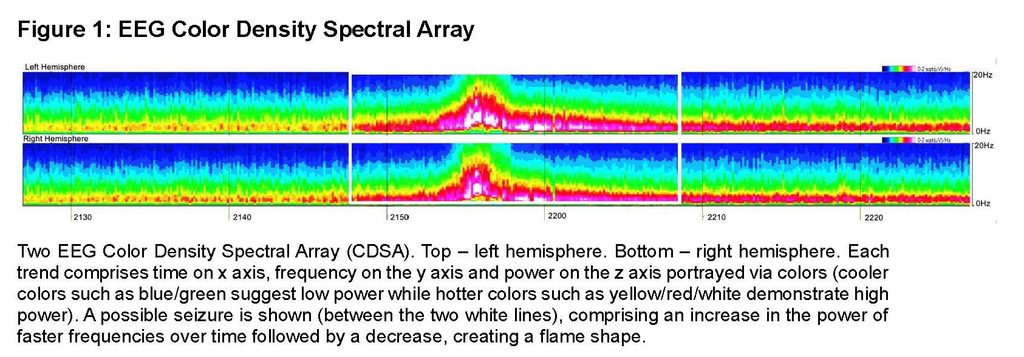
Quantitative EEG (qEEG) consists of visually simplified, time compressed displays summarizing various elements of electrographic data (frequencies, amplitude, power, and rhythmicity). One form of qEEG is color density spectral array (CDSA) that utilizes Fast Fourier Transform (efficient algorithm that breaks down a signal into its constituent frequencies, revealing amplitudes and phases) of raw EEG data to display the power of each frequency (measuring how many times electrical inpulses repeat in one second, measured in Hertz [Hz]) at any moment in time (Scheuer & Wilson, 2004) (Figure 1. Since seizures are often comprising of an abrupt onset of rhythmic epileptiform activity (signifying cortical hyperexcitability, often indicating a high risk for seizures) that evolves in frequency , morphology, and location; these transient changes can be appreciated easily on CDSA as a flame shape (Figure 1).
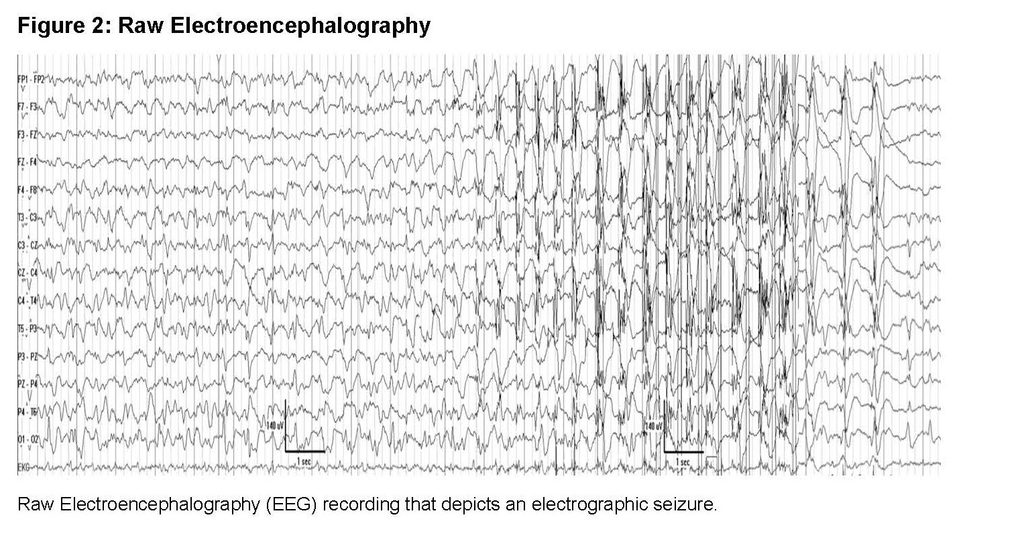
It has been suggested that qEEG can be used by nonexperts to select cEEG epochs (extracted segment of cEEG recording that is divided into smaller chunks, usually centered around a particular event) of interest for focused review by electroencephalographers (Dericioglu et al., 2015; Westhall et al., 2015; Williamson et al., 2014; Zhou et al., 2019). This results in reduced time burden with acceptable sensitivity, but a high false positive rate, associated with EEG artifacts and other non-seizure abnormalities, that may be reduced with concurrent raw data interpretation. However, few robust curricula exist to train nonexperts to develop knowledge and skills in raw EEG (Figure 2) as a complement to qEEG interpretation . Therefore, we developed, implemented, and evaluated a cEEG curriculum to train critical care nurses on how to perform a two-step screen of quantitative (CDSA) followed by raw EEG for seizures.
Methods & Procedures
The study was approved by the Conjoint Health Research Ethics Board (CHREB). Kern’s six step approach to curriculum development, consisting of a general needs assessment, targeted needs assessment, outlining goals and objectives, creating content, implementing the curriculum, and evaluating the curriculum (Kern et al., 2009) was used to inform the creation of the EEG curriculum.
Needs Assessment
A general needs assessment was performed in the form of a systematic review focusing on the structure and outcomes of educational programs for training non-electroencephalographers in performing and screening adult EEG was conducted and published (Kromm et al., 2021). Following this, critical care Registered Nurses (RNs) were identified as targeted learners for the curriculum, given their educational background, constant bedside presence, and experience with other physiologic monitoring for potential pathologies. A targeted needs assessment was conducted through a survey of 55 ICU RNs at a 36 bed general systems ICU at a Canadian academic medical centre (Foothills Medical Centre, Calgary, Alberta) (Appendix). Questions pertaining to comfort and interest level focused on three main areas: 1) seizure principles, 2) EEG principles, and 3) EEG and CDSA interpretation. In addition to this survey, an audit of available learning resources pertinent to continuous EEG at this institution was conducted, revealing a brief document introducing the EEG machine and describing basic machine operations and electrode reapplication.
Objectives & Curriculum Development
The primary goals and objectives for the curriculum based on the general and targeted needs assessment goals were for RNs to acquire knowledge regarding basic seizure and EEG principles, as well as the necessary skills required to screen quantitative (CDSA) followed by raw cEEG for potential NCSz.A spiral curriculum ,where topics are revisited multiple times throughout a program, increasing in complexity and depth with each encounter, of 15 tutorials was developed, detailing basic neuroanatomy, seizure, and EEG principles, as well as an approach to quantitative (CDSA) and raw EEG interpretation (Appendix). Each tutorial contained specific learning objectives, content presentations with visual aids, and additional resources. Corresponding practice modules were available consisting of theory-based questions and EEGs to interpret. The curriculum was available online through www.teachingmedicine.com.
Participant Recruitment & Pilot Implementation
Following the survey, ICU RNs were invited to participate in the study. Participation was voluntary and RNs were randomly selected from those who expressed interest in participating. Participants received a $150 CAD honorarium upon completion of the EEG curriculum. Participants were given three months to complete the curriculum. For pilot curriculum implementation, participants registered through www.teachingmedicine.com/skills/neuro and completed 15 tutorials and 12 associated practice modules. Immediate feedback was provided during the practice modules, indicating whether responses were correct or incorrect and providing an explanatory rationale. Evaluation & Feedback (Appendix). The tests assessed participants’ ability to perform EEG screening for seizures with a particular focus on raw EEG interpretation, including assessment of artifacts, and identification of seizures versus other EEG abnormalities such as burst suppression, or rhythmic and periodic EEG patterns. The surveys assessed perceived confidence with specific knowledge and skills and sought feedback on various elements of the curriculum. Additionally, participant demographic information, including age, gender, nursing role, years of experience, and prior knowledge about seizures and EEGs, was collected.
The primary outcome of interest was the participants’ diagnostic accuracy ofsensitivity and specificity, when screening for seizures. Secondary outcome measures were time to complete the tutorials and practice modules, performance in artifact and seizure identification, confidence in seizures and EEG principles, artifact and seizure identification on EEG and CDSA. Performance was assessed using pre-and post-tests, while confidence was measured through pre-and post- surveys.
Data Collection & Statistical Analysis
Data was collected from the www.teachingmedicine.com/skills/neuro online modules. Upon participant completion , the data was de-identified and exported to comma separated variable (CSV) format. SAS software (Version 9.4, Cary, NC) was used for the statistical analysis. The accuracy of each question was summarized using univariate analysis. McNemar’s tests were used to compare accuracy in recognition of EEG artifact and seizures before and after completion of the educational curriculum. The Mantel-Haenszel test was used to assess the overall impact of the curriculum across EEG categories. Generalized linear models were fit using generalized estimating equations (PROC GENMOD in SAS) to assess the effects of age, ICU experience, and nursing role on test performance. A p value of 0.05 or less was considered statistically significant.
Results
Needs assessment
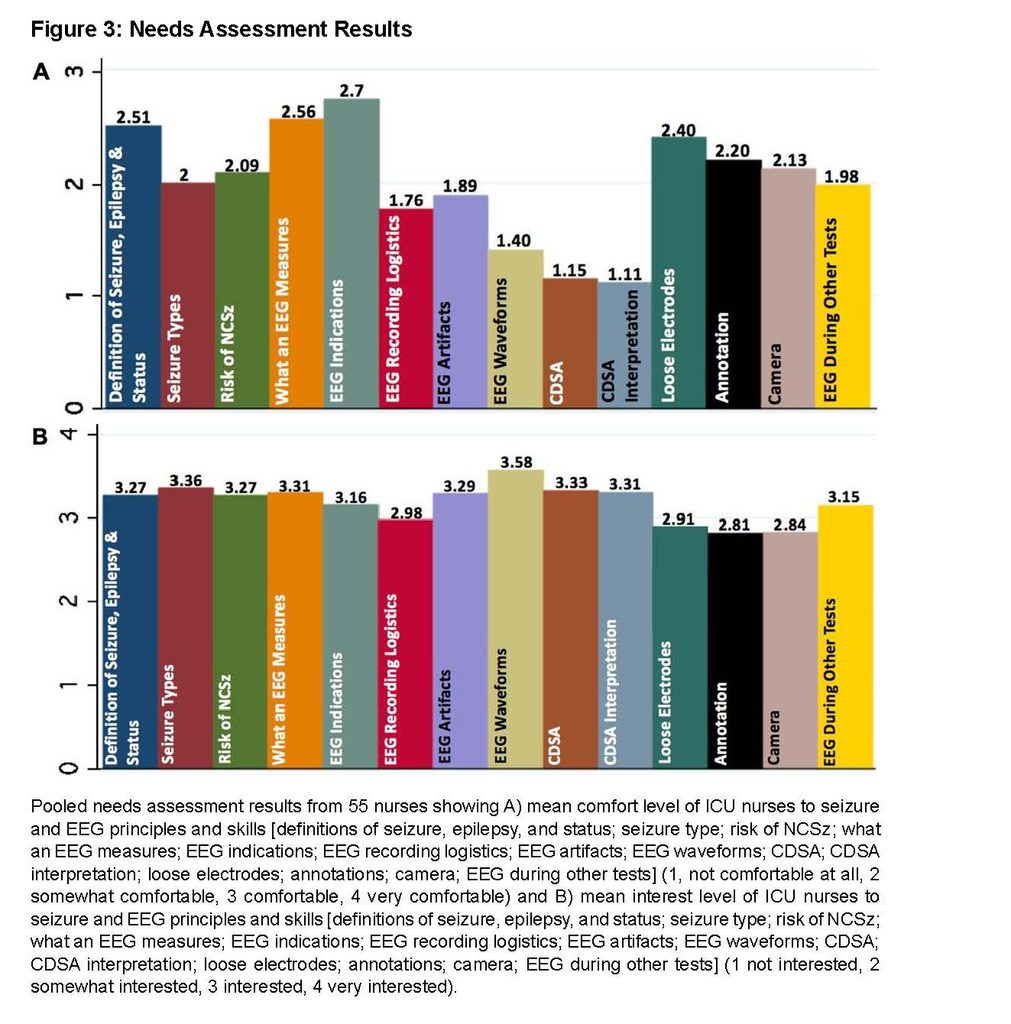
55 nurses completed the targeted needs assessment survey (100% response rate). Respondents’ experience working in ICU ranged from 3 months to 22 years. The survey responses also revealed that 44-88% and 30-80% of RNs lacked confidence in their knowledge of basic seizure and EEG principles, respectively (Figure 3). Comfort in basic EEG and CDSA interpretation skills were reported as a deficit in 94% and 100% of the 55 respondent RNs, respectively. Post curriculum responses indicated the interest in an EEG curriculum, and various methods of learning were favoured. The most requested method (76%) involved hands on practice (data not shown).
Pilot curriculum implementation & evaluation
Demographics
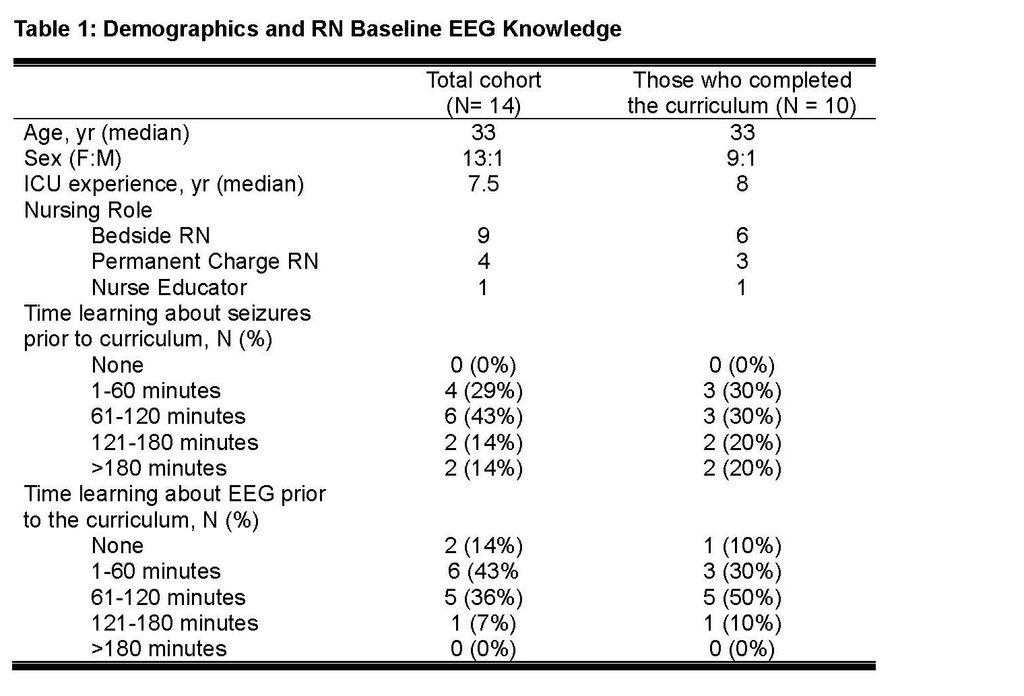
From the original 55 respondents to the survey, 14 participants volunteered and consented to participate in the study. The median age of participants was 33 years [IQR 32-38], predominantly identified as female, and reported a median of 8 years of ICU nursing experience [IQR 4-9] . 10 participants completed the curriculum. One participant withdrew after being accepted into a master’s program and no longer having sufficient time to participate. Reasons for non-completion were not obtained from the remaining three participants. Among those who completed the curriculum, one was an ICU nurse educator, three were nurse clinicians/charge nurses, and six were bedside RNs. . Most participants reported120 minutes or less of prior education related to seizures (72%) and EEG interpretation (93%) (Table 1).
Engagement with Curriculum
The total time spent on the 15 tutorials was 2 hours or less for all participants. Time spent on the practice modules ranged from 1-2 hours (20%), 2-4 hours (40%), and 5 hours or more (40%). The additional resources listed at the end of each tutorial for those requiring more teaching were only utilized by 40% of participants.
Curriculum Efficacy
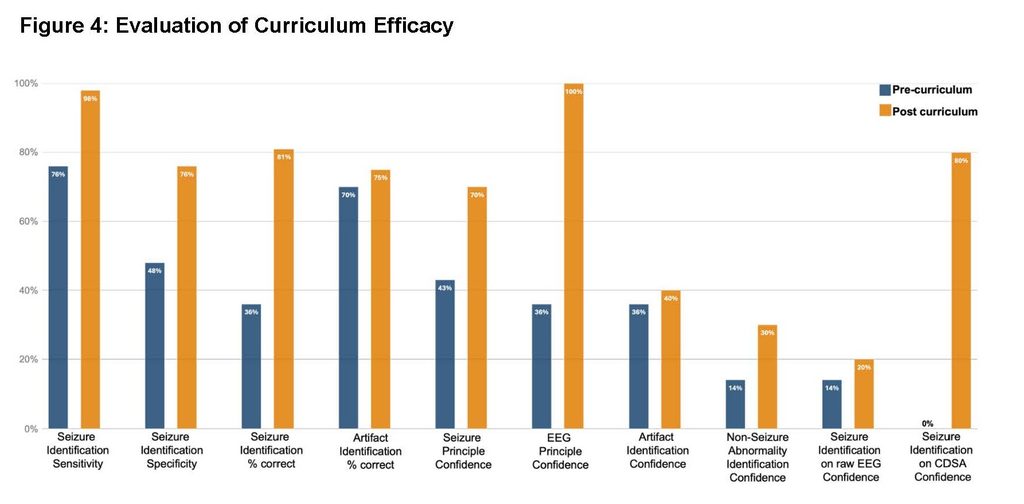
The sensitivity and specificity for seizure identification in the post-curriculum test were 98% (95% CI, 90-100%) and 76% (95% CI, 61-88%), respectively. This was substantially improved from the pre-curriculum test where sensitivity and specificity for seizure identification were 76% (95% CI, 61-88%) and 48% (95% CI, 38-59%), respectively (Figure 4). The most common EEG abnormalities to generate a false positive during raw EEG screening in decreasing order were sporadic epileptiform discharges, burst suppression, periodic discharges and rhythmic delta activity (data not shown). Rarely were artifacts ever misinterpreted as seizure.
Participant performance relating to seizure identification significantly improved from pre- to post-curriculum (36% vs 81%, p <0.0001), however artifact identification did not (70% vs 75%, p = 0.21) (Figure 4). When modeled as a continuous variable, the improvement in test performance between pre- and post-curriculum was reduced in more experienced RNs (p = 0.04), but this effect did not persist when experience was dichotomized by those with the most vs. the least experience (p = 0.18). Improvement in performance was not modified by age (p=0.27) or RN role (bedside RN vs nurse clinician/educator) (p=0.50).
Both pre and post completion of the curriculum, participants rated their confidence with seizure and EEG principles, as well as identification of EEG artifacts and seizures (on raw EEG and CDSA) using a 5-point Likert scale of agreement/disagreement with statements of confidence relating to each topic (1 – strong disagree, 2 – disagree, 3 – neutral, 4 – agree, 5 – strongly agree).
Before completing the curriculum, participants who reported confidence levels of agree or strongly agree were most confident in seizure principles (43%), EEG principles (36%), artifact identification (36%), and non seizure EEG abnormalities, such as burst suppression and rhythmic and periodic discharges (14%), or in seizure identification on raw EEG (14%). No participants reported confidence in seizure identification using CSDA (0%) (Figure 4).
Following the curriculum, participants reported increased confidence in seizure identification (70%), EEG principles (100%), and seizure identification on CDSA (80%)(Figure 4). Smaller improvements were observed in confidence related to artifact identification, recognition of non-seizure EEG abnormalities, and seizure identification on raw EEG (Figure 4).
Feedback
Post-curriculum responses indicated that80% of participants thought the curriculum was efficient and 60% thought the curriculum was effective. The main themes identified included RNs wanting dedicated time and compensation to learn about neuromonitoring modalities such as EEG, requests for various other teaching methods (including didactic teaching) and practical resources (such as a pocket manual), and the formation of an ICU RN super user group which would facilitate future peer teaching and support.
Discussion
Via evidence-informed methods, we successfully designed, implemented, and evaluated a spiral curriculum comprised of electronic tutorials and practice modules designed to provide ICU RNs the necessary knowledge and skills to screen for NCSz. The curriculum was associated with improvements in participant performance and confidence across several domainsincluding increased sensitivity and specificity for NCSz identification.
NCSz occur commonly in critically ill patients and have been associated with increased mortality, and worse functional outcomes (Payne et al., 2014). This is likely a result of secondary brain injury that have been associated with seizures, including metabolic crises, brain tissue hypoxia, elevated intracranial pressure, increased mass effect and midline shift, and hippocampal atrophy (Bencsik et al., 2024; P. Vespa et al., 2016; P. M. Vespa et al., 2007, 2010; Witsch et al., 2017). As such, rapid identification of harmful seizures via EEG and treatment are paramount and means to facilitate this are crucial.
Similar to our study, several others have demonstrated effective educational strategies to improve NCSz detection. While our study focused on educating ICU RNs, others have shown that many other “non-experts” including medical students, residents, fellows and neurodiagnostic technicians can be educated to perform and screen various formats of adult EEG resulting in reduced delays in EEG completion, and changes to management in 40-50% of patients (Kromm et al., 2021). Several studies have focused on training non-experts to screen sonified (converting EEG data to audible sound) and various forms of quantitative EEG. The sensitivity of non-experts screening of sonifed and quantitative EEG for NCSz has varied between 95-100% and 40-93% respectively (Kromm et al., 2021). Specificities have varied between 65-85% for sonified EEG and 38-95% for quantitative EEG (Kromm et al., 2021).
Sonified and quantitative EEG offer the advantage of simplified and time-compressed EEG trends that can theoretically be screened relatively more easily and efficiently than raw EEG. However, when screening sonified or quantitative EEG, false negatives may occur with NCSz that are low in amplitude, low in frequency, focal, brief, or have characteristics that prevent them from standing out compared to the EEG background. False positives can arise from artifacts and other EEG patterns as demonstrated in our study. Both may cause significant clinical consequences including ongoing NCSz, neurophysiologic disturbances, mortality, complications, increased length of stay, and additional health care costs. While it is ideal to obtain confirmation by neurophysiologists of potential NCSz that have been identified by non-experts, high false positive rates would cause this approach to be arduous and non-sustainable. Reported false positive rates for NCSz within the acute care setting which hypothetically could translate into neurophysiologist notifications have ranged from 3.2/hr to 1/10hrs in studies (Kromm et al., 2021).
Raw cEEG can be difficult and time consuming to review for ICU bedside care providers who have other clinical responsibilities. When combined however with qEEG, select epochs can be reviewed to confirm or refute potential NCSz identified on qEEG. Other studies have shown that after educating non-experts to screen raw EEG their sensitivity and specificity for NCSz varies between 63-100% and 65-100% (Kromm et al., 2021) respectively which is comparable to the sensitivity of 98% and specificity of 76% achieved by our study participants. Our study differs from these other studies, as we focused our educational efforts on RNs, whereas others have mainly focused on medical students, residents, fellows. Our curriculum also focused on a two-step process whereby potential seizures would be identified on CDSA, then on raw EEG as opposed to isolated review of raw EEG.
Another means by which accuracy of NCSz identification may be improved is the approach taken by Kang and colleagues who performed a prospective study where qEEG was utilized at the bedside by ICU RNs who received individualized, patient-specific qEEG instructions while caring for patients, with examples provided of what CDSA, amplitude EEG and rhythmicity spectrogram tracings had looked like during previous seizures. With this pragmatic approach, RNs had excellent diagnostic accuracy in recognizing seizures (sensitivity 85%, specificity 89%) and a high rate interobserver agreement (Kang et al., 2019).
In our study, RN confidence did not always correlate with competence. Although ICU RNs were relatively proficient in identifying EEG artifacts at baseline, a disconnect remained between performance and confidence with 64% reporting low confidence before the curriculum and 60% reporting confidence afterward. While significant improvement was noted in seizure identification from pre- to post-curriculum tests (36 vs 81%, p <0.0001), 80% of RNs still lacked confidence in this skill after completing the curriculum. Studies have shown that self-assessment of skill is poor, and confidence is a multidimensional construct that can be influenced by many factors including stress, cognitive load, emotions, uncertainty, and group dynamics (Gottlieb et al., 2022). While most curriculums focus only on competence, confidence and its relationship to competence (competence-confidence ratio) is also important to monitor and foster to develop both mindful and capable professionals who can self-reflect and calibrate appropriately (Gottlieb et al., 2022).
Overall, the feedback for our curriculum was that it was effective and efficient. However, several constructive comments were provided including requests for dedicated time and compensation for training, in addition to other teaching methods and resources. A recent study (Marks et al., 2021) that evaluated rapid deployment of critical care nursing education during the COVID-19 pandemic found that a combination of a distributed practice model which gives critical care learners short bursts of didactic teaching over a longer period is beneficial for cognitive processes, retention, and psychomotor skill acquisition, which is supported by prior research (Gerbier & Toppino, 2015). We offered our curriculum electronically, however, based on the feedback from our participants, it may be beneficial to offer a combination online and in-person/didactic format with tutorials and individualized and hands on cEEG interpretation training to support various learning styles over a longer period (i.e. 6-12 months) to maximize knowledge retention and skill acquisition.
In addition to modifying the curriculum style, resources, and period in which participants have to complete it, we have also developed a Neurocritical Care Champion (NC3) group for ICU RNs and ICU respiratory therapists (RTs) at our center with the goal of improving the chain of survival and recovery for patients with life threatening neurological disorders. Our aim, through focused education activities and resources such as an online EEG curriculum and other educational activities (lectures, grass roots educational publication, drop-in sessions, and journal club), to empower the NC3 participants to not only provide comprehensive neurocritical care (NCC) but also utilize their knowledge and skills to support colleagues and serve as a team resource.
Limitations
Limitations of our study include its small size due to limited funding. This was compounded by 29% attrition. However, this attrition was informative in identifying barriers to curriculum completion and developing solutions to address these in the future. We also enrolled a convenience sample without randomization and thus our results cannot be generalized outside the group of RNs included in the study.Critical care is a demanding specialty with increased complexity, frequent life-threatening situations, and need for prompt decision making based on available data points. The complexity of critical care patients is increasing, however, the time and resources available to train and support critical care practitioners has not (Joyce et al., 2017).
Conclusion
Piloting this curriculum that focused on training ICU RNs in a two-step screening process of CDSA and raw EEG for NCSz was both novel and informative for future studies aimed at developing processes to facilitate more timely diagnosis and management of NCSz in critically ill patients. In addition, further refinement and implementation of this curriculum will improve ICU RN knowledge and skills, broaden their scope of practice and potentially improve their job satisfaction. Our spiral curriculum comprising of online tutorials and practice modules was effective at improving ICU RNs’ diagnostic accuracy for detection of NCSz with the ultimate goal of creating processes to facilitate more timely diagnosis and management of NCSz in critically ill patients.