Preparing critical care nurses in Canada: An environmental scan of post-graduate programs
CJCCN: Volume 37, Number 2
Sydney Gnenz, BScN, RN, Hana Sherif BScN, RN, Matthew J. Douma, PhD, RN, Joan Harris, MHSc, RN, Christopher Picard, MN, RN, and Carmel L. Montgomery, PhD, RN
Abstract
Purpose: The aim of this study was to provide an overview of post-graduate adult critical care nursing education programs across Canada.
Background: Critical care nurse shortages have created an influx of novice nurses entering intensive care units (ICUs). Limited research is available that describes post-graduate critical care nursing education programs in Canada. These programs provide education on complex topics and advanced training in clinical skills to prepare nurses to care for patients experiencing critical illness and admission to ICU.
Methods: We conducted an environmental scan of Canadian university and college websites and email communication with the critical care post-graduate program coordinators. Two reviewers collected information on all programs offered by post-secondary institutions with certification specific to critical care for novice nurses. The results were summarized and presented in narrative form.
Results: We identified 15 critical care programs across Canada. Mean (SD) program costs were $2,740 ($1,788), ranging from $0 to $7,800 and clinical placements included 157 (45) hours, ranging from 0 to 280 hours. Employer support ranged from no funding to full funding.
Conclusion: The findings of our environmental scan reveal remarkable variations in program duration and costs. These results contribute to the current understanding and further discussion about critical care nursing education in Canada. Further investigation is needed to understand nurse experiences with these programs and their impact on organizational, nursing, and patient-centered outcomes.
Implications to Practice: This study provides a foundation for discussing current critical care nursing education and increases awareness of available programs and their characteristics. Access to consistent, high-quality training may help to ensure a sustainable supply of skilled ICU nurses across Canada.
Keywords: critical care; ICU; post-graduate nursing education; nurse.
Patients experiencing critical illness require specialized nursing care in intensive care units (ICUs) (Gisbrecht, 2020; Park & Bokyoung, 2024; Patil et al., 2023). In addition to entry-level nursing competencies, critical care nurses require additional education to assess complex patients, use clinical judgment, and implement life-sustaining measures (Park & Bokyoung, 2024). Historically, ICU nurses were required to have acute care experience before entering the ICU (Baudoin et al., 2022). However, recent nursing shortages in Canada have necessitated increased orientation of new critical care nurses, resulting in many ICUs hiring newly graduated nurses (Giesbrecht, 2020). Many new graduates entering ICUs report feeling unprepared for the transition, partly due to a lack of nursing experience and limited instruction on critical illness in undergraduate curricula (Baxter & Edvardsson, 2018).
Benner et al. (1992) suggest that nursing proficiency is developed through education, experience, and understanding. This may be addressed through postgraduate education that bridges the theory-practice gap. Post-graduate certificate programs provide extensive coverage of complex topics and offer additional training, thereby enhancing nurse competence and confidence (Baxter & Edvardsson, 2018). Investing in advanced, specialized education supports career development, ultimately increasing the likelihood of retention (Yarbrough et al., 2016).
However, critical care nurse training in Canada varies significantly by province (see supplementary data). In contrast, other countries, such as Australia, have nationally standardized requirements that at least 50% of ICU nurses possess a post-graduate qualification (Chamberlain et al., 2018). Similarly, Norway mandates eighteen months of post-graduate training, including 28 weeks of clinical practice (Wallander et al., 2023). ICUs with a higher ratio of post-graduate-qualified nurses have improved patient outcomes (Ross et al., 2024). Although countries such as Australia and Norway have published research on critical care education, there is a notable lack of literature from Canada. This gap presents a challenge for nurses interested in critical care careers and for decision-makers regarding ICU training pathways. The aim of this study was to provide an overview of post-graduate adult critical care nursing education across Canada to inform nursing students, frontline nurses early in their career, and policy decision-makers.
Methods
The environmental scan was conducted to systematically retrieve data from online sources following published guidelines (Graham et al., 2008; Wallander et al., 2023). Environmental scans are a recognized method of healthcare research used to inform policy and guide evidence-based decision-making for program development. This approach was selected to identify and present the post-graduate critical care nursing education available, to identify existing gaps in program offerings, and to inform the development of future programs in Canada (Charlton et al., 2019).
A literature search was performed using the CINAHL database, and minimal literature was found discussing post-secondary critical care nursing education in Canada. This finding supported the need for an environmental scan to fill the research gap and explains why our primary sources of information are from non-academic resources.
We consulted researchers with environmental scan experience to design a framework of inclusion/exclusion criteria and data categories through multiple rounds of review. Programs were included if they (1) focused on critical care nursing education; (2) had publicly available online resources; (3) were available in English; and () were open to applicants who had completed an undergraduate nursing degree program. Exclusion criteria were (1) nursing residency programs – structured education programs to aid in the transition of new graduate nurses into critical care (Chung & Lim, 2025), (2) hospital-specific orientations, (3) inactive programs, and (4) undergraduate-only programs.
We conducted our environmental scan in June 2024. Two authors (SG and HS) reviewed online resources, including Critical care nursing programs provided by the Canadian Association of Critical Care Nurses (CACCN, n.d.). We then performed a Google search using the keyword “critical care nursing education in Canada,” screening the first 100 results. This cross-verification confirmed findings across multiple sources. Programs were cataloged and data was extracted by SG into Google Sheets and verified by a second reviewer (HS) (see supplementary data). Discrepancies were discussed by the two extracting authors and the supervising author (CLM) to achieve consensus. Standardized emails were sent to program coordinators requesting missing information. Initially, 16 categories of program characteristics were identified. Four additional categories were added in response to review and feedback from co-authors (Appendix A). We collected publicly available information and our email communications with program representatives were transparent. As such, formal ethics approval was not required by the University of Alberta.
Results
A total of 59 Canadian institutions offering nursing programs were initially identified. After screening, 21 institutions were confirmed to provide post-graduate critical care courses. Four programs were excluded before email follow-up. One program, Eastern Health (Eastern Health, 2025), was eliminated based on website information indicating it was not a post-graduate course. Following email outreach to 20 institutions for additional information, four more programs were excluded: two institutions (Kwantlen Polytechnic [Kwantlen Polytechnic, 2025] and Georgian College [Georgian College, 2025]) no longer offered the courses, one (Hospital for Sick Kids) was an in-house residency program (Hospital for Sick Kids, 2025), and the Michener Institute was entirely employer-run and only available through hospital sponsorship (Michener Institute, 2025). Twelve programs responded to the email inquiry, while eight did not. After review, fifteen programs met the established inclusion criteria (Figure 1). The 15 identified programs varied in several key aspects, including curriculum design, clinical components, and costs (Table 1). Additionally, seven universities have partnered with local health authorities to offer programs that are either entirely covered or significantly reduced in cost to the nurse (Table 1).
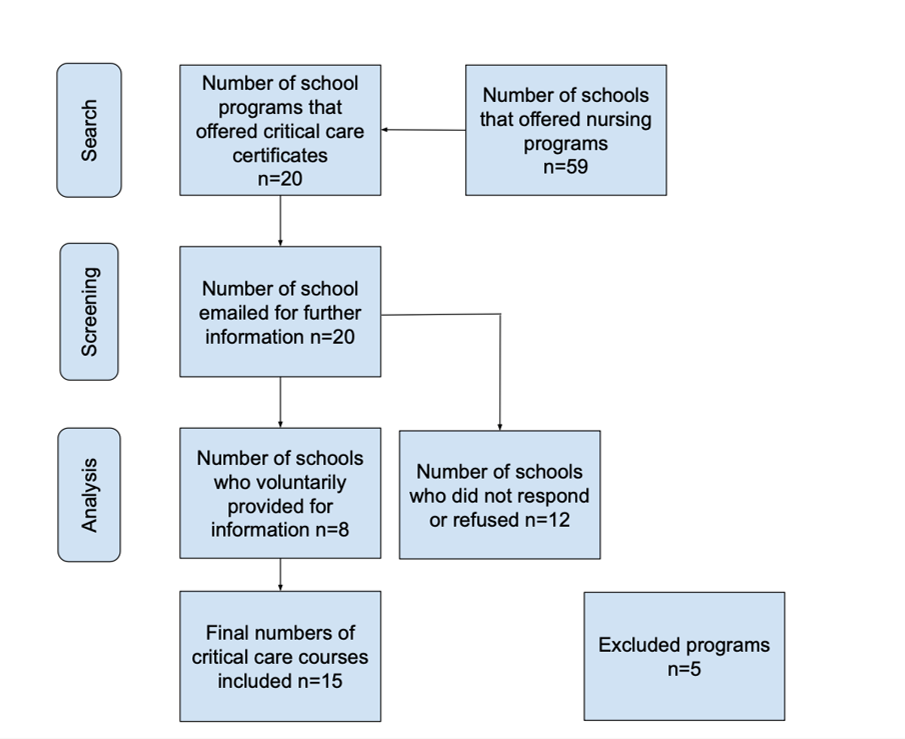
Figure 1. Flow of the selection process for included critical care programs
Program Characteristics in British Columbia
In British Columbia (BC), specialty education is offered through the British Columbia Institute of Technology (BCIT) (BCIT, 2025). BCIT provides a comprehensive program that delivers five online theory courses and two clinical practicum courses with a total of 225 hours of clinical experience (BCIT, 2025). In 2023, approximately 700 students were enrolled in BCIT’s program, which included a combination of employer-sponsored and self-funded participants.
Program Characteristics in Alberta
Post-graduate certification in Alberta is offered through two institutions. The first, Mount Royal University (MRU) offers a program based on four theory courses and a 210-hour clinical course component to meet the Level I program requirements (MRU, 2025). MRU enrollment was 80 students in 2023 (MRU, personal communication, June 7, 2024). The second program, MacEwan University, did not disclose its program curriculum development or overall enrollment statistics (MacEwan University, 2025). The MacEwan program does not include a clinical component. However, it is one of the few fully online, self-directed programs with three required courses. The program is offered at a lower cost, $1,820 compared to $5,800 at MRU (MacEwan University, 2025; MRU, 2025).
Program Characteristics in New Brunswick, Prince Edward Island, and Saskatchewan
In other provinces, institutions such as the University of New Brunswick (UNB), University of Prince Edward Island (UPEI), and Saskatchewan Polytechnic maintain strong partnerships with local health authorities where health system employers support nurses through tuition sponsorships and salary funding, individually or in combination, during the program (Table 1). UNB provides six online courses along with a 135-hour clinical practicum course (UNB, 2025). The growing demand for critical care programs in New Brunswick has prompted the expansion of available spots in the upcoming academic year (UNB, personal communication, June 18, 2024). UPEI structures its program into four phases, offered online and asynchronously, supplemented by in-person skills laboratories and 120-180 hours of clinical, depending on the participant’s previous experience (UPEI, 2025). Saskatchewan Polytechnic offers three theory courses either online or in-person and one 180-hour clinical placement (Saskatchewan Polytechnic, 2025) (Table 1).
Program Characteristics in Ontario
The province of Ontario hosts the largest number of programs, with nine of the fifteen programs nationwide. All programs have a clinical component (mean [SD] 157 [45], range 84-280 hours), except the University of Windsor, which offers seven online modules that prepare students to attend an in-person simulation lab to complete their certificate (University of Windsor, 2025) (Table 1). The University of Windsor program costs $1,349 (University of Windsor, 2025). The remaining eight programs comprise 2-11 courses offered online, hybrid or in-person, and 0-2 in-person simulation labs, and 1-4 clinical practicum placements (Centennial College, 2025; Conestoga College, 2025; Durham College, 2025; Humber College, 2025; Mohawk College, 2025; St. Lawrence College, 2025; Algonquin College, 2025; George Brown College, 2025). Overviews of curricula in at least two programs reference Practice Standards for Critical Care Nursing in Ontario (Critical Care Services Ontario, 2018). Program costs for individual nurses in Ontario range from those fully employer-sponsored, along with a salary during study, to entirely self-funded. Mean (SD) tuition costs among Ontario programs were $2,282 ($533), ranging from $1,349 to $3,069. The attendance and enrollment data were largely unavailable for this province as they were either not publicly reported or not disclosed by the institutions. However, George Brown College had approximately 150 to 180 students enrolled annually (George Brown College, June 6, 2024) (Table 1).
Table 1. Key Characteristics of Post-graduate Critical Care Education Programs
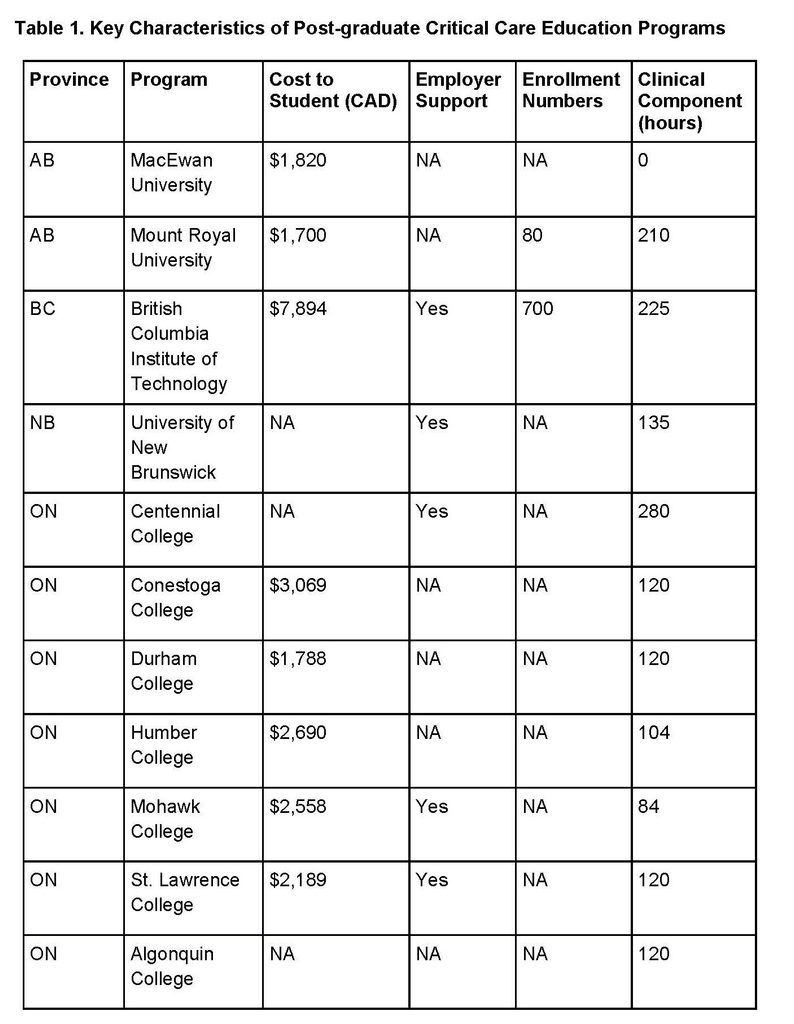
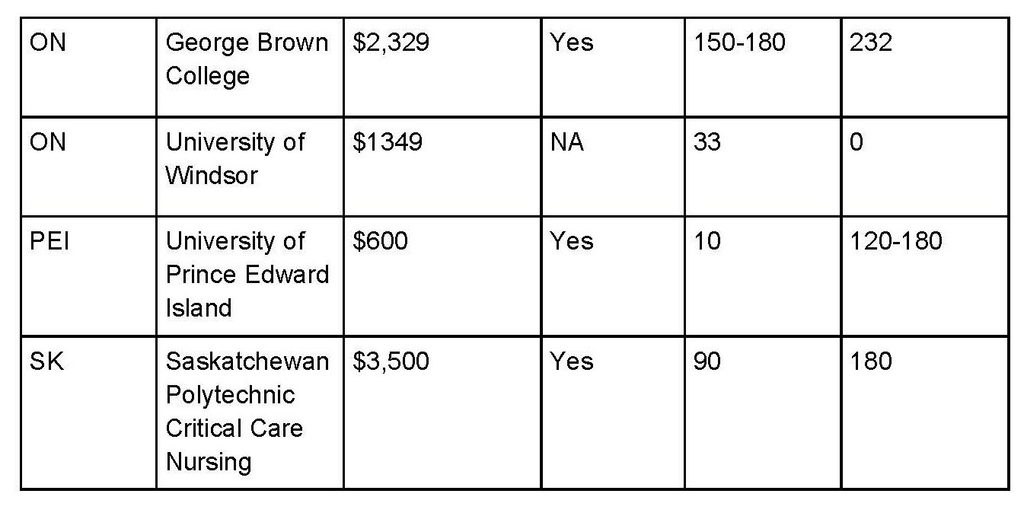
Note: NA = Not Available. This table includes data collected from university websites and responses from program coordinators. Values are approximate and current at the time of extraction.
Discussion
This study revealed various post-graduate university- and college-based education options for Canadian nurses seeking foundational critical care nursing knowledge and skills. BCIT reported the highest enrollment rates and Ontario colleges and universities offered the greatest number of critical care certification programs. In contrast, Alberta’s critical care education programs were dominated by the employer-provided Orientation Program for Adult Critical Care in Alberta (OPACCA), which all new ICU nurses complete as part of their orientation (Alberta Health Services, 2021). The presence of OPACCA likely reduces the demand for alternative programs in the province. Tuition costs varied considerably across programs, especially between programs that included a clinical preceptorship component and those that did not. In addition, the duration of clinical preceptorships in critical care education programs was also found to be inconsistent. Further investigation is warranted to explore these differences and to determine their impact on nurse readiness to practice. Differences between Canadian programs in areas such as clinical hours and employer tuition support may contribute to confusion for nurses who are seeking post-graduate education, as well as employers.
Interprovincial discussion regarding national licensure and standardized training is ongoing in Canada (Canadian Nurses Association [CNA], 2025). Developing standardized critical care curricula could support this initiative by ensuring a consistent baseline level of training adaptable to specific clinical contexts (Monforto et al., 2020). In a study of a critical care orientation program, a redesigned standardized format improved attendance and content knowledge among participants (Monforto et al., 2020). Evidence supports that both in-house residency programs and postsecondary-led education programs have improved nurse experiences and influenced patient outcomes (Baxter & Edvardsson, 2018; Chamberlain et al., 2018; Innes & Calleja, 2018). However, additional comparative research is needed to evaluate existing critical care training pathways in Canada and their respective impact on nursing competency and patient outcomes.
Recent updates to the CACCN Standards for Critical Care Practice (CACCN, 2024), along with the ongoing Canadian Nurses Association (CNA) exam-based certification program, offering credentialing in critical care as a specialty area, are well-positioned to support standardization of education programs. Further investigation is needed in Canada to assess the quality of available programs, their alignment with national standards, and their measurable effect on patient outcomes.
In a post-pandemic call to action, Murphy et al. (2022) suggest that continuing education and increasing access to specialty-specific education are key focus areas for investing in Canadian nurses. These calls to action were made to revitalize the nursing workforce and create sustainable strategies for improving working conditions (Murphy et al., 2022). The CNA reported that nearly 21,000 nurses were working in critical care settings in 2021 (CNA, 2021). Investing in these nurses and supporting their continued specialty education has been shown to contribute to healthier work environments and increased job satisfaction (Nowrouzie et al., 2016; Wei et al., 2023). As employers contend with ongoing staffing vacancies, widespread intent to leave among nurses, the demand for well-prepared critical care nurses will remain a serious challenge for employers as well as educational institutions responsible for their training (Aiken et al., 2002). Recent national efforts, such as Health Canada’s Nursing Retention Toolkit, emphasize initiatives that can be implemented to address the challenges of nurse retention to improve working conditions and retain nurses across the country (Health Canada, 2024).
This presents an opportunity to support continuing education by increasing accessibility of critical care education programs. McKillop et al. (2016) found that nurses are motivated to pursue programs that enhance their knowledge and critical thinking skills; however, barriers such as cost and time commitments limit participation (Trinier et al., 2017). While several programs reviewed included financial support from employers, this key element may be a source of inequity and can create barriers to access in regions of Canada where similar support is not available (Cardel et al., 2020). Although several barriers could be inferred from the data, financial variability was most prominent, evident in the higher reported attendance in provinces where employer support was available.
Implications for Nursing Practice
Post-graduate critical care nursing program options present an upstream approach to addressing the shortages in critical care units. Nurses who pursue advanced education and personal resources have demonstrated higher retention rates in ICUs (Oldland et al., 2023). To improve the benefits of critical care programs, advocacy is needed to establish consistent financial support, such as employer funding, to reduce financial barriers and enhance accessibility. Such efforts may increase participation and broaden the impact of specialized post-graduate education on nursing practice. Further research to assess nurse experiences with critical care programs, adequacy of curricula, availability of employer support, and subsequent effects on nursing and patient outcomes could strengthen the evidence supporting standardized national approaches to critical care nursing education.
Limitations
While this environmental scan provides a valuable overview of critical care nursing programs available to nurses across Canada, several limitations should be acknowledged. First, the use of only two sources to identify programs may have limited the findings. However, we are confident that these sources reflect the typical strategies used by nurses when searching for critical care programs offered by public institutions, which are generally accustomed to engaging with prospective students. Second, data collected from post-secondary school websites may be outdated, as program details change frequently. Third, we relied on publicly available information and limited access to complete data for some programs. As a result, key data such as attrition, enrollment, completion, and acceptance rates were often unavailable. To address these gaps, we emailed program coordinators to request additional information to improve accuracy. However, responses varied, with some providing incomplete details and others not responding at all. Despite these limitations, this environmental scan offers a meaningful overview of current critical care post-graduate education programs in Canada and highlights areas for potential standardization and future research.
Conclusion
This environmental scan included fifteen Canadian critical care nursing programs and provides an overview of the current landscape of post-graduate critical care education. Our findings reveal remarkable variations in tuition costs, clinical hours, and employer funding, which may pose challenges for nurses seeking advanced training options. This environmental scan highlights opportunities for dialogue about variation among programs and the need to identify optimal preparation for nurses entering critical care settings in Canada.
Raw data collection from post-graduate programs.